
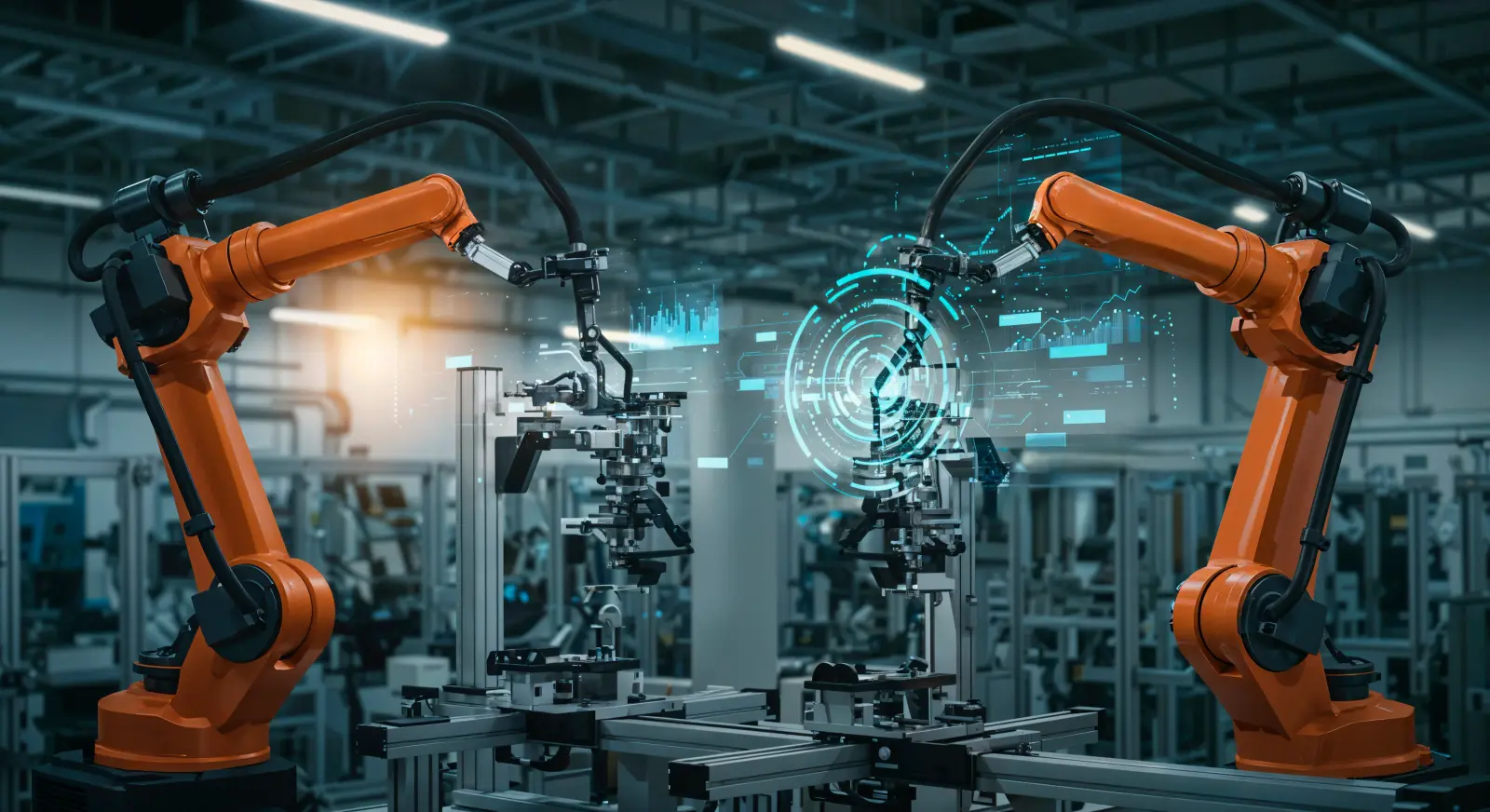
Industry 4.0 is the fourth industrial revolution — the shift from isolated machines to a connected, cyber-physical system in which equipment produces data and acts on it. The real value of that shift lies in turning shop-floor data into decisions, and this is exactly where ERP belongs. ERP is the backbone that links a raw machine signal to decisions about inventory, cost and delivery. This article explains, step by step, how the two fit together.
Most companies investing in their factories run into the same question. New sensors, robots and automation lines are in place — but where does all that data flow, and who acts on it? Industry 4.0 is not simply a matter of buying equipment; it is a matter of whether the data those machines generate can talk to the rest of the business. In the sections that follow, we walk through the layers of a smart factory, the logic of data capture and the role ERP plays in the picture — and how to avoid the familiar trap of “we invested but never gained visibility.”
What is Industry 4.0?
Industry 4.0 describes an approach to production in which processes are connected through sensors, network links and software, and are able to manage themselves to a significant degree. The term was first introduced in Germany in 2011 as a government strategy for digitizing manufacturing. The core idea is simple: machines do not merely run — they also generate data about their own state and share it.
To place the concept in context, it helps to look at the sequence of industrial revolutions:
- Industry 1.0 — steam power and mechanical production (late 18th century).
- Industry 2.0 — electricity and the assembly line (early 20th century).
- Industry 3.0 — electronics, PLCs and automation (1970s).
- Industry 4.0 — connected devices, data and cyber-physical systems (today).
What separates the fourth stage from the ones before it is the constant, two-way conversation between the physical world (machines, products, the shop floor) and the digital world (software, data, analytics). This is what makes a system cyber-physical: a real machine has a digital counterpart, and the two move in step.
The smart factory and its building blocks
The smart factory is where the principles of Industry 4.0 take concrete form. Here a production line does more than make products — at the same time it produces signals about its own performance, the energy it consumes and the faults it may be approaching. Several core components make this possible.
Data capture and sensors
Everything starts with measurement. Quantities such as temperature, vibration, pressure, speed, counts and position are read continuously by sensors. Without this data-capture layer, no analysis at the layers above is possible. What matters is not the number of sensors but reading the right data, from the right point, at the right frequency.
IoT and connectivity
Captured data has to reach somewhere. IoT (the Internet of Things) is the technology layer that lets physical devices exchange data over a network. In a factory, this means connecting machines to central systems through PLCs, gateways and industrial protocols. For a closer look at what IoT is and how it talks to ERP, see our article on what IoT is and how it integrates with ERP.
Automation and robotics
Repetitive, heavy or precision-critical tasks are handed off to robots and automation systems. What sets automation apart in Industry 4.0 is that these systems also generate data and can adapt their behavior in response to central decisions.
Digital twin and analytics
A digital twin is a live software copy of a physical asset — a machine, a line or a product. It is fed by the real system, which means a change can be tested digitally first and its effect observed before it is applied. The analytics layer, in turn, extracts patterns, trends and anomalies from the accumulated data.
Where does ERP fit in this picture?
The layers described so far generate and transport data. But what a production quantity means, what a stoppage costs, when an order can be shipped — these are operational and financial questions. ERP (Enterprise Resource Planning) is the software that unifies a company’s processes — finance, inventory, procurement, manufacturing, quality and human resources — in a single data model. In the smart factory, ERP is the layer that translates shop-floor data into the language of the business.
An example makes this concrete. A machine reports that it “produced 4,200 units this shift.” On its own, that is just a number. ERP places that number into context:
- Which work order it belongs to, and how it compares with the planned quantity.
- Automatic deduction of the consumed raw material from inventory.
- The labor and energy share reflected in the cost of the finished goods.
- The effect on the shipping schedule and the customer’s delivery date.
In other words, without ERP, Industry 4.0 data stays trapped in a dashboard that can be read but never acted on. With ERP, the same data becomes a live input feeding decisions about cost, planning and delivery.
Where the OT and IT worlds meet
Factories have traditionally had two separate worlds: OT (Operational Technology) — the machines and control systems on the floor — and IT (Information Technology) — the enterprise software. The promise of Industry 4.0 is to bring these two together. ERP sits at the center of the IT side and typically exchanges data with the OT side through a MES (Manufacturing Execution System) or directly via IoT gateways. The sturdier this bridge, the less data has to be carried by hand, and the fewer errors creep in.
Turning production data into financial and operational value
ERP’s principal contribution in the smart factory is to let different departments look at the same data from a single source of truth. The table below summarizes the difference between a conventional setup and an integrated Industry 4.0 setup.
| Process | Conventional approach | Industry 4.0 + ERP |
|---|---|---|
| Output tracking | Manual entry at end of shift | Automatic, live feed from the machine |
| Inventory deduction | Periodic counts, delayed | Deducted in step with production |
| Downtime logging | Operator note, incomplete | Automatic from sensors, with cause |
| Cost visibility | Aggregated at month-end | Continuous, per product and work order |
| Maintenance | React after breakdown | Data-driven, preventive planning |
The practical result of this difference is straightforward. Management can see which line is profitable and which product is eroding its margin without waiting for month-end. Procurement can order against real consumption. Planning can make commitments based on real capacity.
Illustrative scenario: an injection-molding manufacturer
The following scenario is illustrative; it does not reflect a real company or verified figures, and is presented only to show the mechanism at work.
An illustrative business producing plastic injection-molded parts operates five press machines. At first, operators wrote production and scrap counts on a form at the end of each shift, and that form was keyed into the system the next day. The result: inventory always lagged by a day, scrap causes were lost, and cost could only be calculated at month-end.
The business added simple counters and status sensors to the presses and connected that data to ERP. Now, each time a part is produced, the work order advances, raw material is deducted from inventory automatically, and stoppages are logged with their cause. Management can see which mold is causing the most downtime the same day, rather than weeks later. The point this scenario is meant to make is not the technology itself but the shift from carrying data by hand to wiring it directly into decision-making.
Where to start? A phased path
There is no requirement to carry out an Industry 4.0 transformation all at once, end to end — and doing so is often ill-advised. A staged path is more manageable:
- Start with visibility. Measure first. Collect basic data from machines (counts, downtime, status) and make it centrally observable.
- Connect the data to ERP. Link the captured data to work-order, inventory and cost processes to reduce manual entry.
- Move to analytics. Once enough data has accumulated, read the patterns; advance to more sophisticated uses such as preventive maintenance and capacity planning.
- Deepen automation. Hand some decisions off to rules and the system, so people can focus on the exceptions.
Along this path, a modular ERP makes it easier to switch on only the piece you need at each step. AinosERP’s module structure — with components such as Manufacturing/MRP, Inventory, Quality, Asset & Maintenance and Reporting & BI — offers a suitable foundation for this gradual progression. On the field side, the IoT and hardware layer acts as the bridge that carries machine data into the system.
The concrete benefits Industry 4.0 brings
The case for transformation is not the technology itself but measurable outcomes. An integrated Industry 4.0 and ERP setup typically touches the following areas:
- Losses become visible. When losses such as downtime, scrap and slowdowns are quantified, management decides with data rather than intuition.
- Manual work shrinks. An automatic data flow reduces the burden of filling in forms and duplicate entry, and lowers the margin for error.
- More reliable delivery commitments. When real capacity is known, the dates given to customers become consistent.
- Cost accuracy. When energy, labor and material are reflected in the product according to real consumption, pricing rests on a solid basis.
The common thread across these benefits is that decisions rest on current data rather than delayed estimates. We assess the industry’s direction on these fronts collectively in our article on 2026 ERP trends.
Which ERP modules stand out in this transformation?
Industry 4.0 data produces value separately across a company’s different processes. The Manufacturing/MRP module manages work orders and capacity; the Inventory module processes consumption in step; the Asset & Maintenance module tracks equipment health; the Quality module monitors process parameters; and Reporting & BI translates all of this into the language of management. You can review how these modules divide the work and combine into a whole in our guide to ERP modules. The critical point is that these modules share the same data model — so that a single reading from a machine can be used consistently across several processes.
Common mistakes
- Collecting data but not using it. If the dashboards are full but no one looks at them to decide, the investment will not pay off.
- Leaving integration for later. Sensors and machines are purchased, and the ERP connection is deferred to “later”; data that has become an island is of no use.
- Trying to do everything at once. When scope grows unchecked, the project bogs down and results are delayed.
- Removing people from the equation. Automation does not devalue the operator; it frees them from repetitive work and redirects them toward interpretation and improvement.
Conclusion
Industry 4.0 and ERP are two halves of the same goal. Industry 4.0 produces a rich stream of data from the shop floor; ERP connects that stream to the company’s financial and operational decisions. Without one, the other is incomplete: a smart factory without integration amounts to dashboards nobody reads, and an ERP that receives no shop-floor data tracks reality from behind. The foundation of the smart factory is an uninterrupted conversation between these two layers. The right approach is not a great leap but a gradual progression that starts with visibility and wires data into decisions. On that journey, a modular ERP that can talk to shop-floor data is the connective element that makes transformation sustainable.
Frequently Asked Questions
What exactly is the relationship between Industry 4.0 and ERP?
Industry 4.0 continuously generates data from machines and processes on the floor; ERP connects that data to business processes such as finance, inventory, planning and procurement. In short, Industry 4.0 is the “measuring and connecting” layer, while ERP is the “interpreting and deciding” layer. When the two work together, shop-floor data becomes operational and financial value directly; when they stay separate, isolated data islands form instead.
Can a small or mid-sized business adopt Industry 4.0?
Yes. Industry 4.0 is not the preserve of large factories alone. Smaller companies usually begin by adding basic sensors to a limited set of critical machines and connecting that data to ERP. Starting at this scale keeps the investment manageable and delivers visible benefit quickly. The point is not to transform the whole factory at once but to advance from the spot that will make the most difference.
Are MES and ERP the same thing?
No, but they complement each other. A MES (Manufacturing Execution System) works close to the shop-floor layer, managing the execution of work orders on the line, production counts and machine status in real time. ERP covers the business as a whole: finance, inventory, procurement, planning. In some setups, ERP also takes on part of the MES function. The right architecture is determined by the scale of the business and the complexity of its production.
Is a digital twin necessary for every business?
A digital twin is a powerful tool, but it is not a priority in every scenario. In complex, costly processes, or ones that require constant optimization, testing a change in a virtual environment first offers real benefit. Where basic visibility and data integration are not yet in place, however, it makes more sense to focus on those steps first. A digital twin gains meaning when it is built on top of a mature data foundation.
How do I measure the return on an Industry 4.0 investment?
The return usually shows up in three areas: reduced manual data entry and the errors tied to it; shorter downtime and fault durations; and lower inventory and delay costs thanks to more accurate planning. To measure it, you need to record baseline values before the transformation (current downtime, inventory accuracy, delivery performance). The continuous, comparable data that ERP provides is the source that makes this measurement possible in the first place.